- 您現(xiàn)在的位置:買賣IC網(wǎng) > PDF目錄296013 > FM24C64LZMT8X I2C Serial EEPROM PDF資料下載
參數(shù)資料
| 型號: | FM24C64LZMT8X |
| 英文描述: | I2C Serial EEPROM |
| 中文描述: | I2C串行EEPROM的 |
| 文件頁數(shù): | 13/14頁 |
| 文件大小: | 103K |
| 代理商: | FM24C64LZMT8X |
8
www.fairchildsemi.com
FM24C16U/17U Rev. A.3
FM24C16U/17U
–
16K-Bit
Standard
2-Wire
Bus
Interface
Serial
EEPROM
Number of
Device Selection Inputs
Address Bits
Density
Page Blocks
Provided
Selecting Page Block
2k bit
1
A0
A1
A2
None
4k bit
2
—
A1
A2
A0
8k bit
4
——
A2
A0 and A1
16k bit
8
———
A0, A1 and A2
Pin Descriptions
Serial Clock (SCL)
The SCL input is used to clock all data into and out of the device.
Serial Data (SDA)
SDA is a bi-directional pin used to transfer data into and out of the
device. It is an open drain output and may be wire–ORed with any
number of open drain or open collector outputs.
Write Protect (WP) (FM24C17U Only)
If tied to VCC, PROGRAM operations onto the upper half (upper
8Kbits) of the memory will not be executed. READ operations are
possible. If tied to VSS, normal operation is enabled, READ/
WRITE over the entire memory is possible.
This feature allows the user to assign the upper half of the memory
as ROM which can be protected against accidental programming.
When write is disabled, slave address and word address will be
acknowledged but data will not be acknowledged.
This pin has an internal pull-down circuit. However, on systems
where write protection is not required it is recommended that this
pin is tied to V
SS.
Device Selection Inputs A2, A1 and A0 (as
appropriate)
These inputs collectively serve as “chip select” signal to an
EEPROM when multiple EEPROMs are present on the same IIC
bus. Hence these inputs, if present, should be connected to VCC
or V
SS in a unique manner to allow proper selection of an EEPROM
amongst multiple EEPROMs. During a typical addressing se-
quence, every EEPROM on the IIC bus compares the configura-
tion of these inputs to the respective 3 bit “Device/Page block
selection” information (part of slave address) to determine a valid
selection. For e.g. if the 3 bit “Device/Page block selection” is 1-
0-1, then the EEPROM whose “Device Selection inputs” (A2, A1
and A0) are connected to V
CC-VSS-VCC respectively, is selected.
Depending on the density, only appropriate number of “Device
Selection inputs” are provided on an EEPROM. For every “Device
selection input” that is not present on the device, the correspond-
ing bit in the “Device/Page block selection” field is used to select
a “Page Block” within the device instead of the device itself.
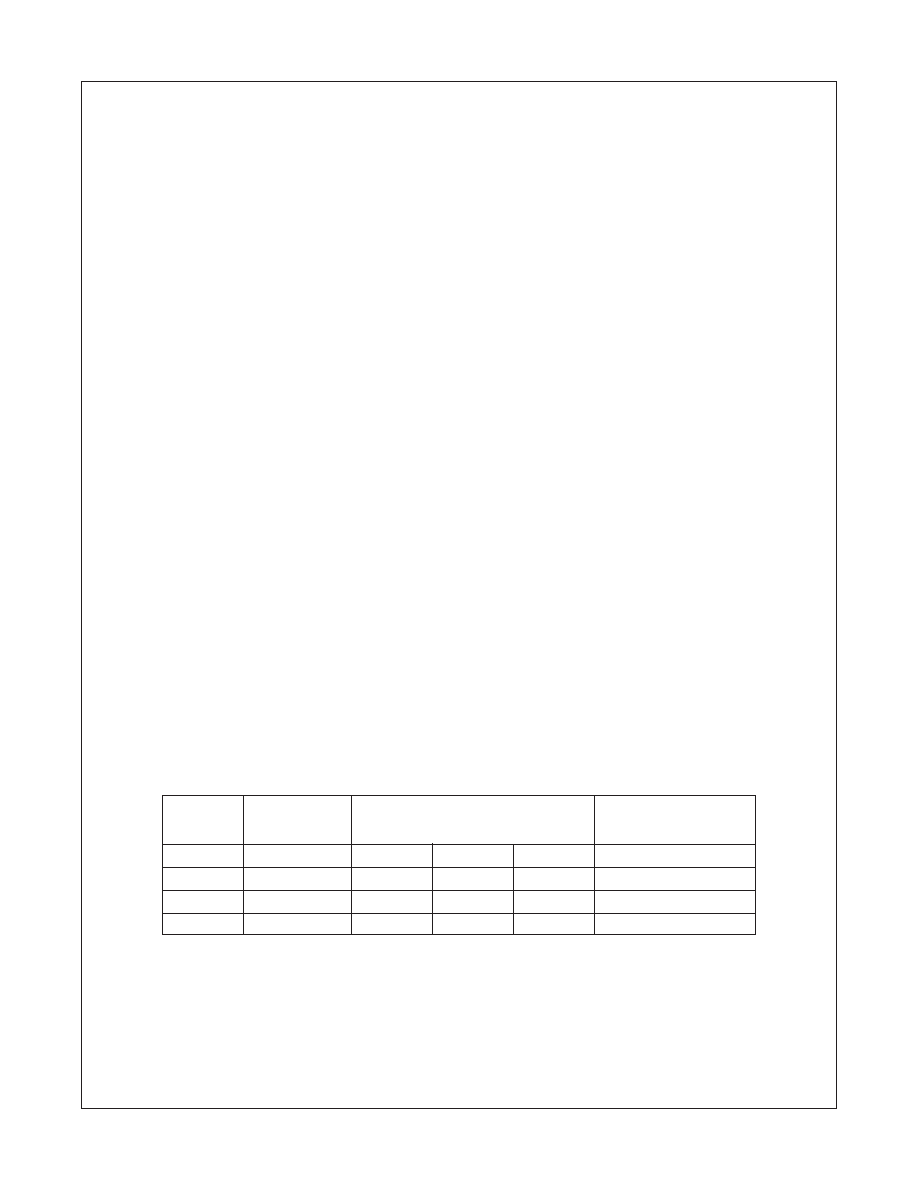
Following table illustrates the above:
Note that even when just one EEPROM present on the IIC bus,
these pins should be tied to V
CC or VSS to ensure proper termina-
tion.
Device Operation
The FM24C16U/17U supports a bi-directional bus oriented proto-
col. The protocol defines any device that sends data onto the bus
as a transmitter and the receiving device as the receiver. The
device controlling the transfer is the master and the device that is
controlled is the slave. The master will always initiate data
transfers and provide the clock for both transmit and receive
operations. Therefore, the FM24C16U/17U will be considered a
slave in all applications.
Clock and Data Conventions
Data states on the SDA line can change only during SCL LOW.
SDA state changes during SCL HIGH are reserved for indicating
start and stop conditions. Refer to
Figure 1 and Figure 2 on next
page.
Start Condition
All commands are preceded by the start condition, which is a
HIGH to LOW transition of SDA when SCL is HIGH. The
FM24C16U/17U continuously monitors the SDA and SCL lines for
the start condition and will not respond to any command until this
condition has been met.
Stop Condition
All communications are terminated by a stop condition, which is a
LOW to HIGH transition of SDA when SCL is HIGH. The stop
condition is also used by the FM24C16U/17U to place the device
in the standby power mode, except when a Write operation is
being executed, in which case a second stop condition is required
after t
WR period, to place the device in standby mode.
相關PDF資料 |
PDF描述 |
|---|---|
| FM24C64LZN | I2C Serial EEPROM |
| FM24C64LZVM8 | I2C Serial EEPROM |
| FM24C64LZVM8X | I2C Serial EEPROM |
| FM24W7S-K121 | 24 CONTACT(S), FEMALE, D SUBMINIATURE CONNECTOR, SOLDER, SOCKET |
| FM5W5P-K120 | 5 CONTACT(S), MALE, D SUBMINIATURE CONNECTOR, SOLDER |
相關代理商/技術參數(shù) |
參數(shù)描述 |
|---|---|
| FM24C64LZN | 功能描述:電可擦除可編程只讀存儲器 DISC BY MFG 7/03 RoHS:否 制造商:Atmel 存儲容量:2 Kbit 組織:256 B x 8 數(shù)據(jù)保留:100 yr 最大時鐘頻率:1000 KHz 最大工作電流:6 uA 工作電源電壓:1.7 V to 5.5 V 最大工作溫度:+ 85 C 安裝風格:SMD/SMT 封裝 / 箱體:SOIC-8 |
| FM24C64LZVM8 | 制造商:未知廠家 制造商全稱:未知廠家 功能描述:I2C Serial EEPROM |
| FM24C64LZVM8X | 制造商:未知廠家 制造商全稱:未知廠家 功能描述:I2C Serial EEPROM |
| FM24C64LZVMT8 | 制造商:未知廠家 制造商全稱:未知廠家 功能描述:I2C Serial EEPROM |
| FM24C64LZVMT8X | 制造商:未知廠家 制造商全稱:未知廠家 功能描述:I2C Serial EEPROM |
發(fā)布緊急采購,3分鐘左右您將得到回復。